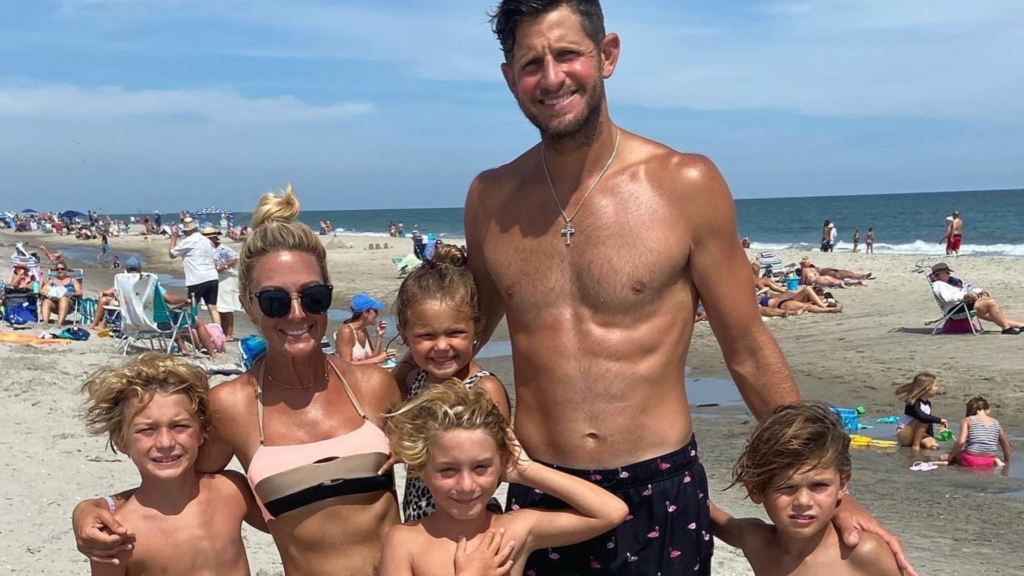
You watch Dan Orlovsky break down plays on ESPN every week. You see the fire, the passion, the whiteboard moments that make football make sense. But behind all of that? There’s a dad of four who’ll tell you flat out — “I don’t think I was naturally born with elite dad skills.” And somehow, that honesty is exactly what makes his family story one of the most compelling in sports media right now.
Let’s talk about it.
Who Is Dan Orlovsky, Really?
Before we dive into the kids, you need a quick snapshot of the man himself — because it makes everything about his parenting style click.
Dan Orlovsky was born on August 18, 1983, in Bridgeport, Connecticut, and raised in the small, tight-knit community of Shelton. He played 12 seasons in the NFL — mostly as a backup quarterback — and if you’re a football fan, you might remember that play where he ran out of his own end zone for a safety with the Detroit Lions. He’s laughed about it a thousand times since. That self-awareness? That’s very Dan Orlovsky.
After retiring in 2017, ESPN came knocking, and the rest is history. He’s now one of the most recognizable voices in football analysis, appearing on Get Up, First Take, and NFL Live. His producer Mark Eiseman has literally received texts from him at 6 a.m. with 30 video clips worth exploring for that week’s shows . Laura Rutledge, host of NFL Live, says he “preps like no one I’ve ever seen in my entire life for anything that he does” .
But here’s the thing — that same obsessive energy he brings to football? He brings it to being a dad. And that’s the story most people miss.
Meet the Family: Tiffany, the Real MVP
You can’t talk about Dan Orlovsky’s kids without talking about Tiffany Orlovsky (née Tiffany Ann Lesher). She is, without exaggeration, the backbone of this family.
Dan met Tiffany in 2006 through a mutual friend — his UConn teammate Jeff Fox — at a wedding. They married on July 6, 2009, during Fourth of July weekend. When Dan was seriously considering a medical sales job after retiring from football, Tiffany literally stopped laughing long enough to ask: “What are you doing?” She recognized his gift of simplifying the game before he did .
While Dan was chasing NFL dreams across four different teams and multiple cities, Tiffany was the constant — the parent who held everything together. During the NFL years, Dan was often away, and Tiffany essentially raised the kids solo during those stretches. She’s the reason this family didn’t fall apart during the chaos. And Dan knows it. He texted her once mid-week saying: “I feel like I’m failing as a husband.” Her response? “It’s annoying how good he is,” she said . If that’s not a real marriage, I don’t know what is.
The Triplets' Birth Story — A Hidden Detail Most People Don't Know
Here’s something that rarely gets reported properly: the story of how Tiffany and Dan found out they were having triplets is wild.
When Tiffany first got pregnant, doctors initially told them they were expecting fraternal twins. That was already exciting news. But then — and this is the part that’s genuinely extraordinary — a follow-up scan revealed that one of those embryos had split. So what started as fraternal twins became identical twins plus a third baby boy.
Tiffany’s reaction? “I think I just went paralyzed,” she recalled.
Dan’s reaction? “This is awesome!”
That contrast pretty much tells you everything you need to know about both of them.
On December 28, 2011, triplet sons Madden, Hunter, and Noah entered the world. Noah is the fraternal triplet, while Madden and Hunter are the identical pair. Dan himself joked about the chaos of having three babies at once: “Every now and then, I’m home alone with them. All I do is frantically search the house for them. I always misplace them.”
Madden Orlovsky: The Artist Who Stopped ESPN in Its Tracks
Madden Orlovsky, now 13 years old, is on the autism spectrum. Dan and Tiffany have never hidden this — in fact, they’ve chosen to celebrate it. And on April 2, 2025 — World Autism Awareness Day — they gave the world a moment that made grown adults cry at their television screens.
Every single piece of studio art on ESPN’s NFL Live that day was drawn by Madden.
Let that sink in. One of the biggest sports networks on the planet turned over its entire visual identity for a day to a 13-year-old autistic boy’s artwork. And it wasn’t a token gesture. The graphics were stunning — animation characters, football art, creative visuals that reflected a mind working in its own beautiful way.
When Dan introduced the segment, he choked up on live television. He called Madden’s drawing his “superpower”.
“He loves art. He loves to draw animation characters,” Dan said, barely holding it together.
After the episode, Dan posted on X: “Cried a lot today — tears of being a proud dad.”
Tiffany shared something even more remarkable with USA Today that most people glazed over: Madden creates at least three new drawings or cartoons every day. Three. Every. Day. Dan has saved hundreds of his son’s comic books — over 300, stored in giant boxes in their basement . He doesn’t throw a single one away.
Think about that as a parent. Dan Orlovsky — a man who analyzes million-dollar NFL plays for a living — also organizes and preserves his son’s artwork like it’s the most important archive on earth. Because to him, it is.
Here’s another insight that doesn’t often get discussed: the UConn Magazine profile revealed that Dan specifically turned down serious NFL coaching offers — including conversations with the Carolina Panthers — partly because he could not uproot Madden from the support network and the people who had helped him grow. He said directly: “He couldn’t rip his kids from their friends and routines or remove his son Madden, who is autistic, from the people who have helped him grow and develop.”
That’s not a small sacrifice. Coaching in the NFL would likely mean millions more dollars and a return to the highest level of the game he loves. He said no.
Hunter and Noah: The Competitive Brothers
Hunter and Noah are the other two pieces of the triplet puzzle, and while they keep a lower public profile than their brother Madden, Dan drops nuggets about them in interviews that paint a pretty vivid picture.
These boys play sports — multiple sports — and they’re growing up in a household where Dad literally played in the NFL. That pressure is something Dan talks about openly and thoughtfully. He says he was very deliberate about not pushing them into intense sports from age three or four like so many parents do with their kids today.
“I didn’t want them to feel that dad did it so you have to,” he told USA Today.
He actually delayed introducing them to competitive athletics on purpose. And here’s the payoff: “I think they’re way more in love with sports now than some of their friends who have been playing for nine, 10 years. I didn’t want the overwhelming burnout to happen,” he said.
There’s a quiet but powerful lesson in that. So many parents — especially parents who excelled in sports themselves — enroll their toddlers in elite training before the kids even know what the sport is. Dan went the opposite direction, and his kids ended up more passionate, not less.
One of his sons (likely one of the triplets) went through a period of serious confidence issues in sports. A coach yelled at him during a game, and the boy fixated on that one negative moment even though he’d played well overall. Dan’s approach? He didn’t dismiss it. He didn’t say “toughen up.” Instead, he taught his son a simple but profound mental framework:
“Talk to yourself rather than listen to yourself.”
That’s the kind of insight that doesn’t come from a parenting book — it comes from a man who spent 12 years as an NFL backup quarterback learning how to drown out the noise of failure and keep showing up.
Lennon Orlovsky: The Little Athlete With Big Dreams
Lennon was born on October 22, 2015, four years after the triplets, and she’s the only girl in the Orlovsky household — which, given that she’s got three older brothers and an ex-NFL dad, probably means she can hold her own in any room.
Dan describes Lennon in terms that are equal parts pride and careful restraint. “My daughter is a superstar athlete, and she’s got every box that you could ever imagine needing to be checked for sports,” he said.
But here’s where Dan shows his maturity as a parent: even knowing she has exceptional ability, he actively monitors how much he praises her performance. “I want to constantly encourage her, but not to the point where she thinks that, ‘Oh my gosh, sports is the only thing that matters, and the only way my dad will love me,'” he explained.
Lennon’s big dream? When Dan gave the kids dinner-table interview questions (a trick he borrowed from entrepreneur Jesse Itzler), Lennon answered the question “What does success look like to you?” with the most Lennon answer imaginable: she wants to live with Mom and Dad and play for the U.S. Women’s World Cup team .
Dan saved that piece of paper . Of course he did.
The Nomadic Years: A Hidden Cost Nobody Talks About
Here’s something the highlight reels never show you: before the Orlovskys settled into their current home in Westport, Connecticut, those kids were in six different schools in four years.
Six schools. Four years. Because Dad kept getting signed and cut and traded and signed again — that’s the NFL life for a backup quarterback. Every time Dan got a new opportunity with a new team, the whole family picked up and moved. New city. New school. New friends to make. New routines to build from scratch.
For most kids, that’s genuinely destabilizing. But for Madden, who is autistic and deeply connected to his routines and support networks, it was especially significant. Dan acknowledges this now, saying one of the reasons he’s so protective of where the family lives is precisely because of what those years cost the kids — especially Madden .
The family has now been in their Westport home for over four years — the longest they’ve been anywhere. And Dan has said clearly: any future professional move, whether coaching or otherwise, will only happen if it has zero negative impact on the family . It’s a hard line, and he means it.
Dan's Parenting Philosophy: The Stuff That's Actually Useful for You
Okay, let’s get practical here, because if you’re reading this as a parent, Dan Orlovsky’s approach has some genuinely useful, under-the-radar ideas worth stealing.
He asks his kids what they need from him — not what he thinks they need. Before games and events, Dan asks each child: “What do you want from me to be your best?” That sounds simple, but it’s revolutionary compared to most sports parents who assume their kid needs encouragement, or discipline, or silence — without ever asking.
He acknowledges he “casts a shadow.” Dan knows his NFL fame creates unconscious pressure on his kids. He says: “I know when I’m at a game I cast a shadow. I have no idea what that feels like.” That kind of self-awareness is rare. Most famous parents never stop to consider how their presence changes the emotional landscape for their children.
He’s involved in the All Pro Dad program. This is a structured initiative that supports fathers through workshops and community activities. Dan doesn’t just talk about fatherhood — he invests in resources and communities that make him better at it.
He packs notes in the kids’ lunch every single day. Even now that the boys are teenagers. Even when they’re probably rolling their eyes at it. Sometimes it’s a Bible verse. Sometimes it’s just a note . He doesn’t care if it’s “age appropriate.” He cares that it happens.
He interviews his kids at dinner. He stole this from Jesse Itzler, but it’s brilliant: giving kids structured questions at the dinner table that require them to think about life beyond today’s homework. “What does success look like to you?” The answers will surprise you .
Faith, Stability, and What Holds the Orlovskys Together
You can’t fully understand this family without understanding the role faith plays in it. Dan is a committed Christian, and he’s said publicly that his faith guides both his personal and professional life. He talks openly about being a “follower of Jesus” and says putting that label on his social media keeps him accountable for how he treats other people.
During the COVID-19 pandemic, Dan described how the family used their extra time together to quietly do acts of service — buying groceries for neighbors, paying for strangers’ meals, dropping off supplies. He said the goal wasn’t to check it off a list; it was to teach the kids what it means to live purposefully.
That combination of faith, intentionality, and raw honesty about his own imperfections is what makes Dan Orlovsky’s parenting story feel real. He’s not a perfect dad. He says so himself. He fumbles conversations with Lennon in the mornings and replays them on the way to work. He worries he handled the knucklehead triplet incident wrong. He texts his wife saying he feels like he’s failing .
But the difference between him and most parents is: he keeps showing up with that same maniacal desire to be better. The same drive that kept him in the NFL for 12 years as a backup. The same drive that made him one of ESPN’s most prepared analysts. He refuses to coast at home any more than he would coast at work.
What Dan Orlovsky's Kids Teach the Rest of Us
At the end of the day, the story of Dan Orlovsky’s kids — Madden, Hunter, Noah, and Lennon — is a story about what it looks like when a parent genuinely goes all in.
It’s Madden’s drawings covering an ESPN studio. It’s Lennon’s World Cup dream written on a dinner napkin, filed in a box for safekeeping . It’s three boys navigating six schools in four years and coming out the other side with a dad who refuses to uproot them again. It’s a former NFL player admitting he doesn’t have elite dad skills, then working like he does.
The triplets just turned 14 in December 2025. Lennon is 10. Dan has said he figures he has maybe six more summers before the kids would “rather drink poison than hang with Dad” . He is making every single one of them count.
If you take one thing from this family’s story, let it be this: the most important plays Dan Orlovsky has ever made weren’t at the Detroit Lions or the Tampa Bay Buccaneers. They were in a house in Westport, Connecticut, at a dinner table with four kids and a stack of lunch notes waiting to be written.
Found this article helpful? Share it with a sports parent in your life — because the real game is always at home.

kidzoot